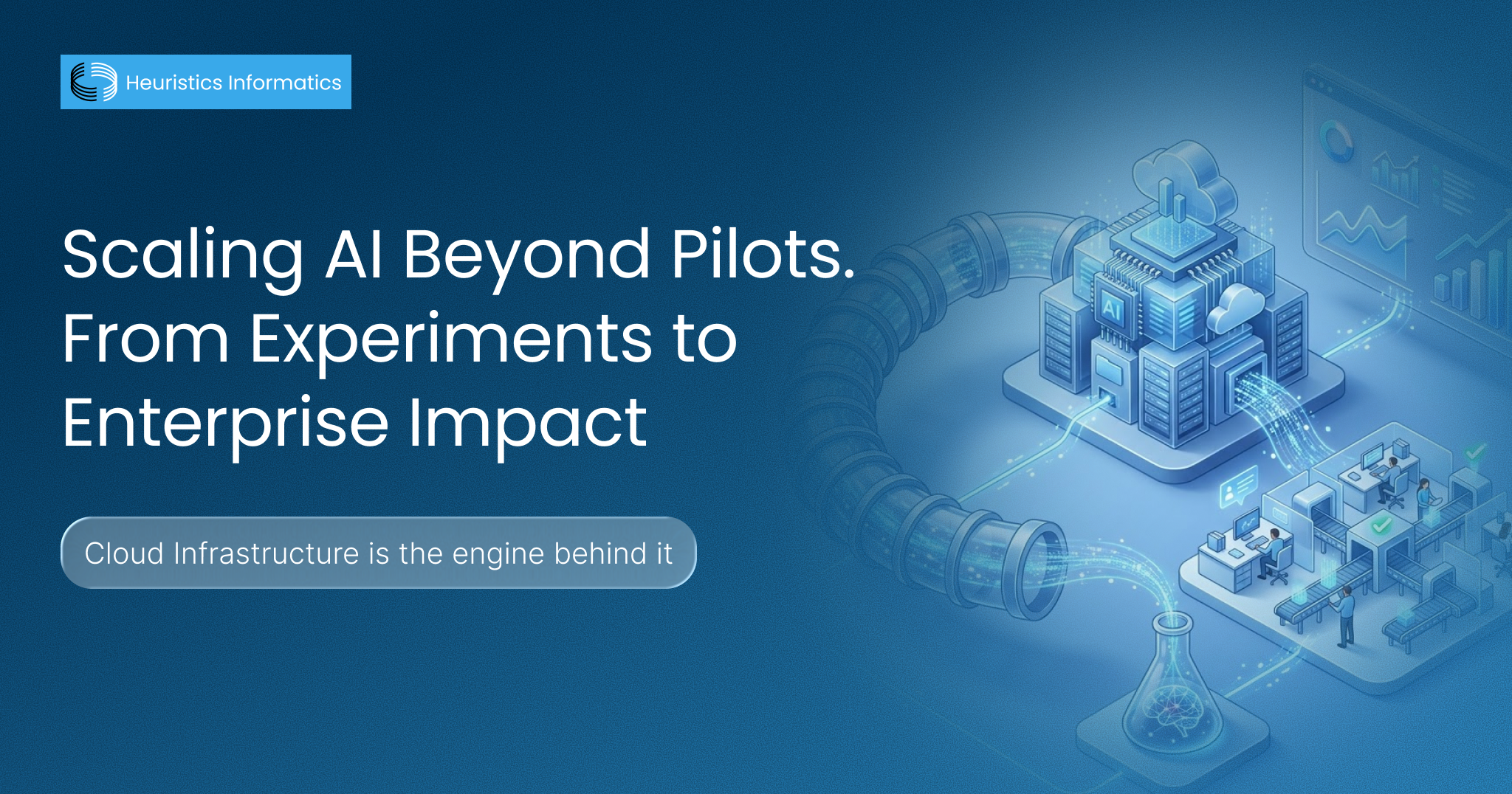
Today, almost every enterprise has experimented with AI. You may have tested a chatbot, built a predictive dashboard, or automated a few workflows. On paper, these pilots look promising. However, the real challenge begins when you try Scaling AI across your organization. This initiates business slowdown.
According to industry estimates, nearly 70–80% of AI projects never move beyond pilot stages. The reason is simple. While experimentation is easy, AI at scale in enterprises requires a completely different level of readiness, technologically, operationally, and strategically.
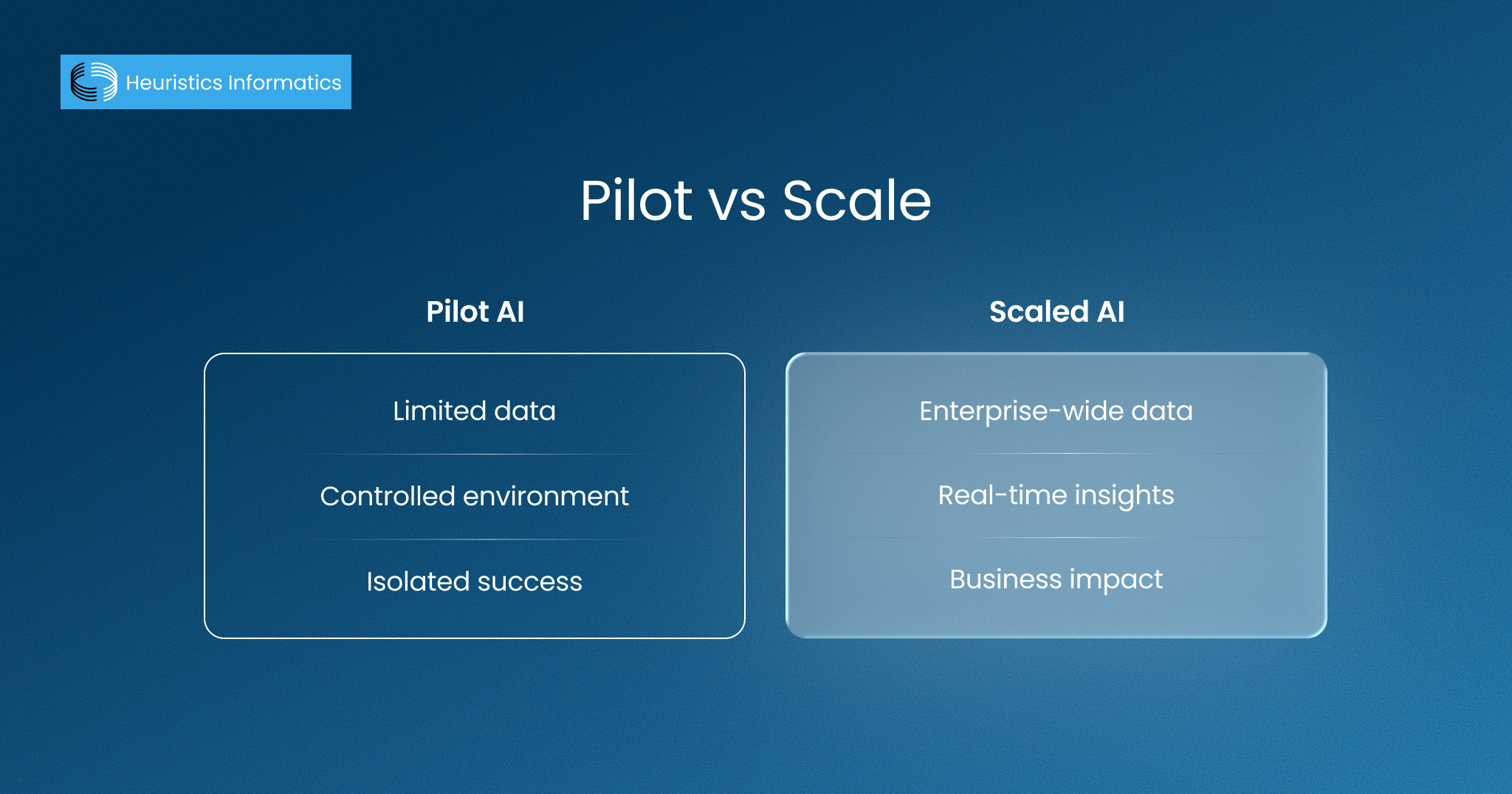
While running an AI pilot is like testing a single electric vehicle, scaling AI is like building an entire electric mobility ecosystem. It needs infrastructure, coordination, and long-term planning. So, how do you move from isolated success to enterprise-wide impact?
That is exactly what this blog explains.
Why Enterprises Struggle to Scale AI
Scaling AI sounds straightforward. However, it is one of the most complex transformations an enterprise can undertake. Many organizations invest heavily in enterprise AI deployment, yet struggle to see measurable outcomes.
Let’s look at where things typically break.
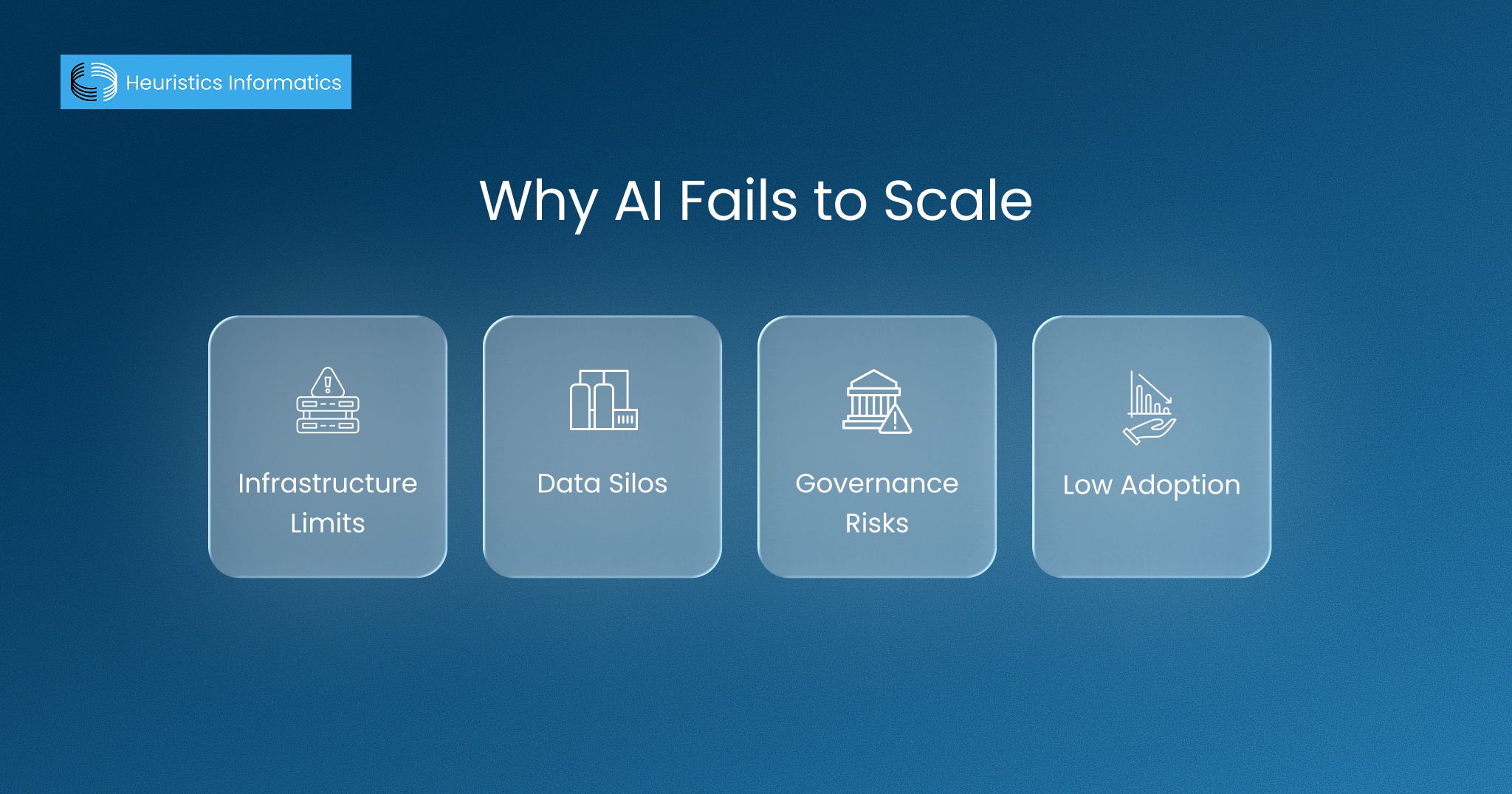
Infrastructure is not built for scale
Most pilot projects run in controlled environments. They don’t face real-world data volumes or system complexities. Once you scale, everything changes.
Data volumes surge. Processing requirements increase. Real-time responsiveness becomes critical. Without the right infrastructure, systems begin to lag, and the value of AI diminishes quickly.
Fragmented data ecosystems
AI depends on connected, high-quality data. But in reality, enterprise data is scattered across systems, ERP, CRM, finance tools, and operational platforms.
A large portion of this data remains underutilized. In fact, estimates indicate that over 60% of enterprise data is never used for meaningful decision-making.
When data is fragmented, AI cannot deliver a complete picture. And when insights are incomplete, decisions suffer.
Governance and security concerns
As AI expands, so do concerns around:
- data privacy
- access control
- regulatory compliance
Enterprises cannot afford to compromise on security. Yet, without structured governance frameworks, scaling AI introduces risk rather than value.
Adoption gaps across teams
Technology alone does not drive transformation. People do.
Many AI initiatives fail because:
- business users are not trained
- systems are not intuitive
- insights are not easily accessible
AI must become part of daily decision-making. Otherwise, it remains a parallel system with limited impact.
Role of Cloud Infrastructure in Scaling AI
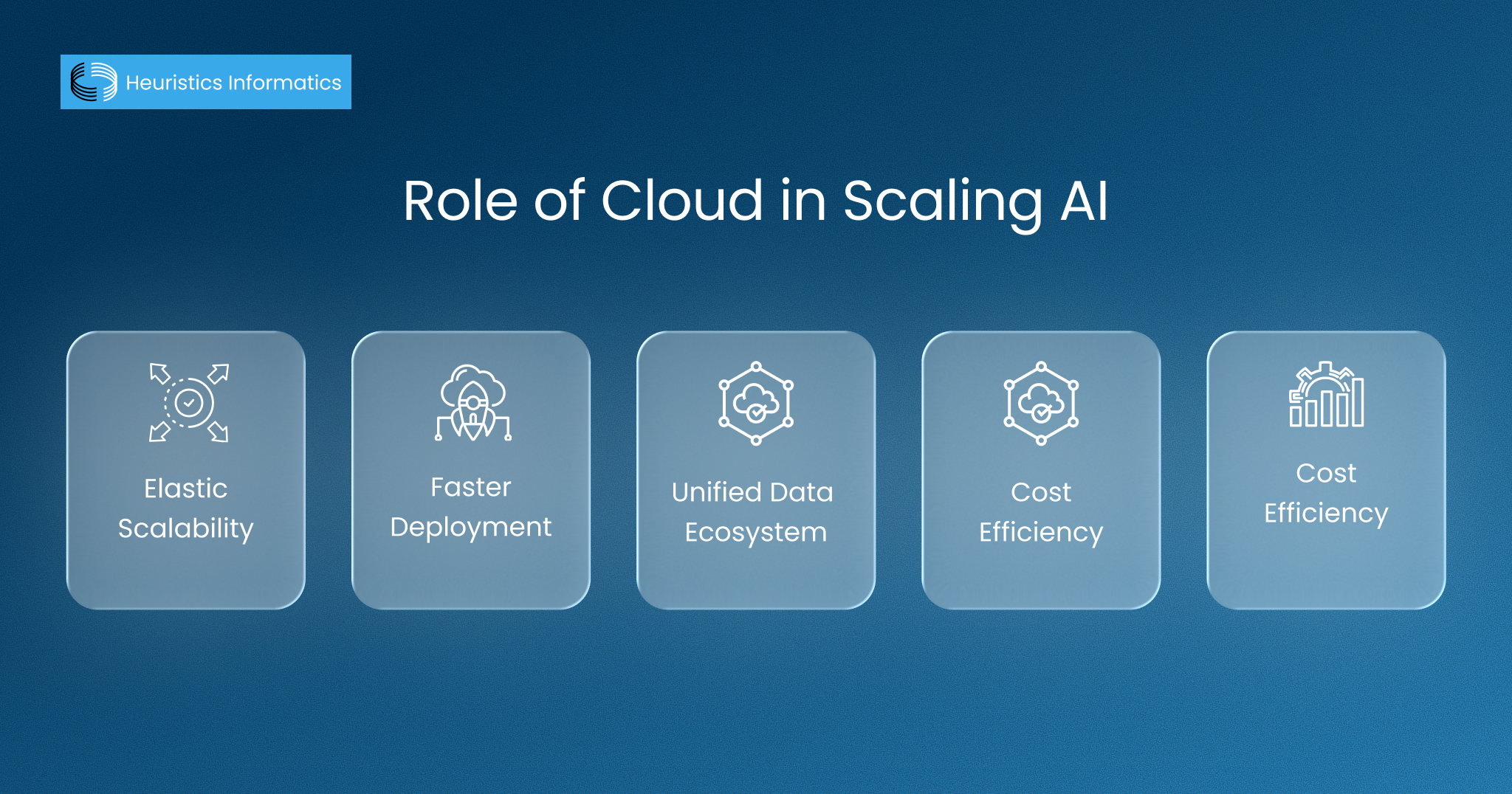
You cannot achieve meaningful Scaling AI without a strong foundation. That foundation is cloud infrastructure for AI. This is where the real shift happens.
Modern enterprises are increasingly relying on cloud infrastructure for AI to move beyond pilot limitations and enable real business impact.
Here’s why.
On-Demand Scalability
AI workloads are unpredictable. Some days require minimal processing. Others demand massive computational power.
Cloud platforms solve this with:
- Elastic compute resources
- Auto-scaling capabilities
- Distributed processing
This ensures your AI systems perform consistently, even under heavy loads.
Faster Deployment Cycles
Traditional infrastructure takes months to set up. Cloud infrastructure for AI reduces this to days, or even hours.
With cloud-based AI solutions, you can:
- Deploy models quickly
- Test and iterate faster
- Roll out updates seamlessly
This speed is critical when your business decisions depend on real-time insights.
Seamless Integration Across Systems
Cloud environments act as a unified layer connecting:
- ERP systems
- Data warehouses
- SaaS platforms
- IoT data streams
This eliminates silos and enables AI to access a complete data picture.
Cost Optimization
Scaling AI on-premise requires heavy upfront investment.
Cloud, on the other hand:
- Works on a pay-as-you-use model
- Reduces infrastructure overhead
- Enables smarter cost governance
This makes scaling sustainable, not just technically, but financially.
Designing Enterprise AI Architecture for Scale
When you think about enterprise AI deployment, you are not just adopting tools. You are building a long-term capability that supports continuous growth.
A well-defined cloud AI strategy focuses on alignment between data, security, and governance.
Data Must Flow Seamlessly
Your AI models rely on consistent and accurate data.
This requires:
- integrated data pipelines
- real-time data availability
- standardized data structures
When data flows without friction, AI delivers insights that are both timely and reliable.
Security Must Be Built In, Not Added Later
As AI scales, access to data increases across teams. You need strong controls in place. Role-based access ensures that users only see what they are authorized to access. Encryption protects sensitive information. Identity management systems enforce policies across environments.
Security is not optional. It is foundational.
Governance Ensures Sustainability
AI systems must remain compliant with evolving regulations.
This means:
- tracking data usage
- maintaining audit trails
- monitoring model performance
Best Practices for Scaling AI Beyond Pilots
Scaling artificial intelligence is not just about technology, but also about execution. Here are practical approaches that work in real enterprise environments.
Start with High-Impact Use Cases
Don’t try to scale everything at once.
Focus on:
- Revenue-driving processes
- Cost optimization areas
- Decision-heavy workflows
This creates immediate value and builds momentum.
Adopt a Phased Rollout Strategy
Move step by step.
Pilot → Department-level deployment → Enterprise rollout
This reduces risk and allows continuous improvement.
Train AI on Live Enterprise Data
Static data limits AI performance.
Instead:
- Use real-time data streams
- Continuously retrain models
- Adapt to changing business conditions
This keeps your AI relevant and effective.
Enable Cross-Team Collaboration
AI should not sit in isolation.
Encourage collaboration between:
- IT teams
- Business users
- Data teams
This ensures better adoption and alignment.
Monitor, Measure, Improve
Scaling is an ongoing process.
Track:
- Model accuracy
- User adoption
- Business outcomes
Then refine continuously.
Measurable Benefits of Scaling AI with Cloud Infrastructure
When done right, the impact of AI at scale in enterprises is significant and measurable.
1. Faster Decision-Making
According to Gartner, organizations using real-time data analytics can achieve 20–25% improvement in operational efficiency.
With AI integrated into workflows:
- Decisions happen instantly
- Insights are always current
- Leaders act with confidence
2. Reduced Reporting Delays
Many enterprises lose thousands of hours waiting for reports.
In fact, internal estimates suggest businesses can lose up to 35,000 hours annually waiting for actionable data.
AI eliminates this by:
- Automating reporting
- Generating real-time dashboards
- Delivering insights on demand
3. Improved Productivity
When AI handles repetitive tasks:
- Teams focus on strategy
- Manual effort reduces
- Output quality improves
4. Stronger Cross-Team Alignment
With a unified cloud AI strategy:
- Everyone works with the same data
- Insights are consistent across departments
- Collaboration becomes seamless
5. Cost Efficiency at Scale
Cloud-based AI solutions ensure:
- Optimized resource usage
- Reduced infrastructure costs
- Better ROI from AI investments
Moving from Pilots to Enterprise Impact
The conversation around AI is changing from experimenting to Scaling AI to drive measurable business outcomes.
Enterprises that succeed are the ones that:
- Move beyond isolated pilots
- Build strong cloud foundations
- Integrate AI into everyday workflows
Because in today’s environment, AI is not a feature. It is becoming the operating layer of modern enterprises.
Platforms like askme360 help enterprises scale AI beyond pilots, leveraging cloud infrastructure to deliver real-time, decision-ready insights. They bridge the gap between data and action, making AI accessible across business functions.
How HIPL and askme360 Enable Enterprise-Scale AI
At Heuristics Informatics Pvt. Ltd., the focus is not just on implementing AI, but on making it work at a scale. With nearly three decades of experience in enterprise systems, cloud, and AI, HIPL understands the real challenges businesses face when moving from pilots to production. Their approach combines deep domain expertise with modern cloud capabilities to build scalable, secure, and high-performance AI ecosystems.

Our AI platform, askme360, is designed specifically for this transition. It connects directly with enterprise data systems and enables users to interact with business data using natural language. Instead of waiting for reports, you can simply ask, and get real-time insights, dashboards, and automated reports instantly.
More importantly, it is built with enterprise-grade security, role-based access, and cloud-native scalability. This ensures your AI initiatives are not just innovative, but also reliable and compliant.
If your goal is to move from experimentation to real impact, this is where the shift begins.